For BMC the straw that broke the camel’s back and got me to work on a new graphic/show control system was requests for help from long time friends still working in entertainment. The first problem I was asked to help solve involves laser graphics and modern video cameras. To understand the problem, let’s first look at the two technologies involved. Laser entertainment projection systems use “vector graphics”. Think Atari Battlezone from 1980:
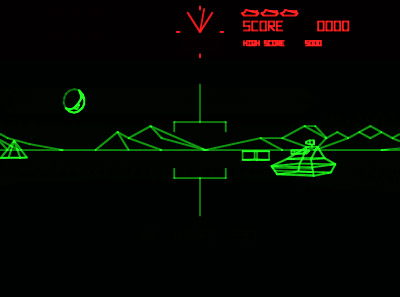
This looks a LOT like 1980’s laser projection graphics (or even 2020 laser projection graphics for that matter) because it is essentially drawn the same way – like an Etch-a-Sketch. What you see is traced by a beam. Internally it is more of a ‘connect the dots’ system, with the beam jumping from point to point (look closely at the dark side of the moon in the image above and you can see the dots). If the beam is ‘blanked’, or off, we don’t see the jump from one point to the next. But if the beam is on, we see a visible line.
Now for the video side. Most modern video cameras use a ‘raster’ system. An image is made from horizontal lines, each containing a fixed number of dots, or pixels. When you see a rating for, say, “8 megapixels” on a camera, that just means that when you multiply the pixels per line by the number of lines, you get eight million(ish). Video and TV’s tend to be specified differently, but it is the same basic thing. Instead of the total number of pixels, they tend to refer to just one dimension. A 1080p setting on your TV is 1920 x 1080 pixels. A 4K image is 4096 x 2160 for production equipment.
Making things more complicated, the entire raster image is not captured at exactly the same time. Generally one line is recorded at time, sort of like the way a scanner or photocopier captures a document, just faster. This is often called a “rolling shutter”. A decent video of how this works can be found here:
In general, a rolling shutter combined with a fast oscillation, like our laser projector, is a problem. It causes projected images to flicker, have dark gaps, distort, etc. in the recorded video. But a rolling shutter can also make for some great effects. Like the iphone inside a guitar video that went viral back in 2011:
We want to do something similar. We want to make artifacts of a rolling shutter combined with projected laser graphics controlled and reproducible. But before we do that, we’ll need to flesh out some technology pieces.
Next up: We’ll meet a modern laser projector